
Year 101
Foundations
Build command of research philosophy, ethics, qualitative and quantitative methods, theory, evidence synthesis and concentration study.




UNIVERSITY OF GOLD COAST ·
Add Scholarly Authority to Professional Distinction
The Gold Coast PhD develops the Scholar Leader: a rigorous scholar and accomplished professional uniting research, judgement and leadership.
The scholar's discipline: read, reflect, publish.
The Scholar Leader campaign
Campaign 01
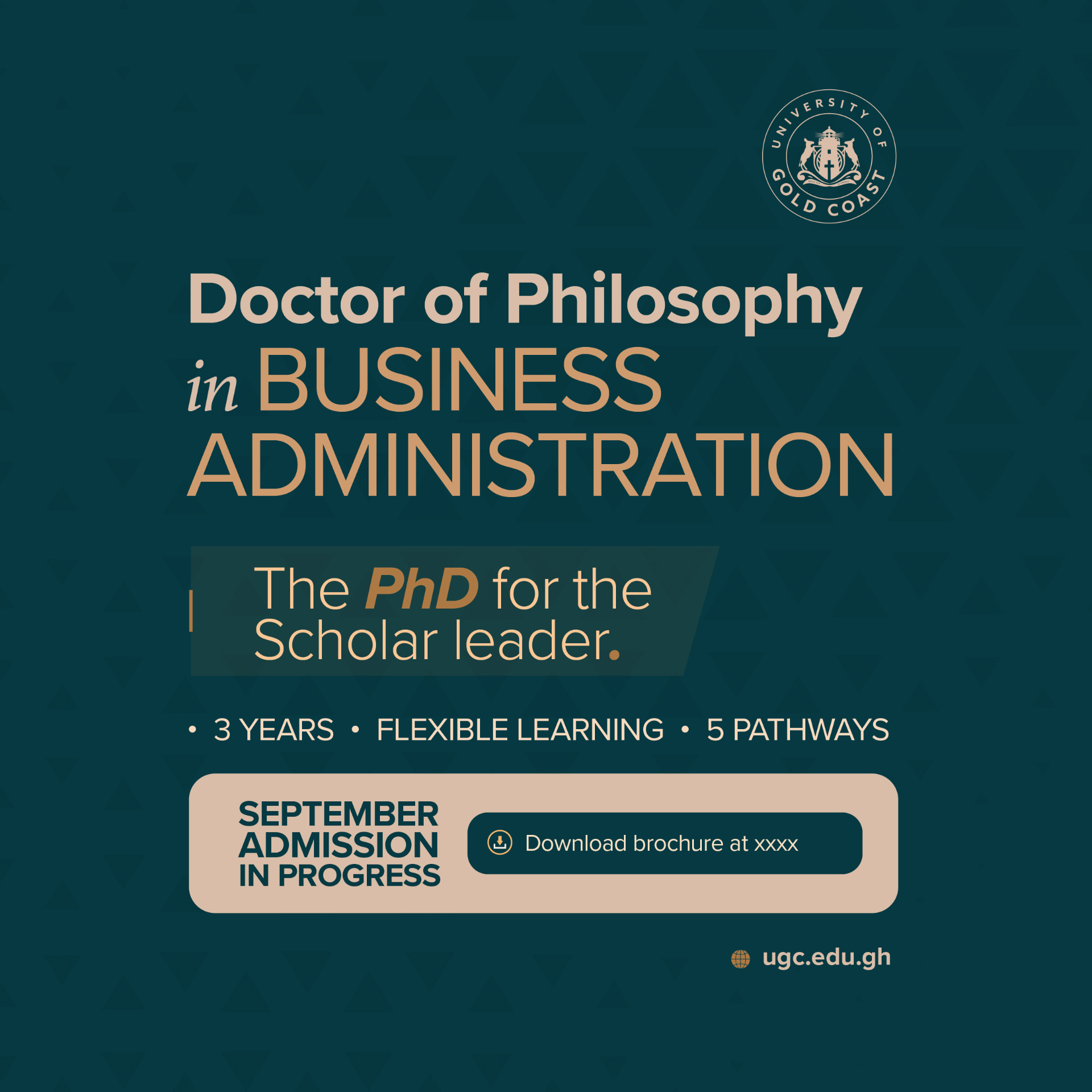
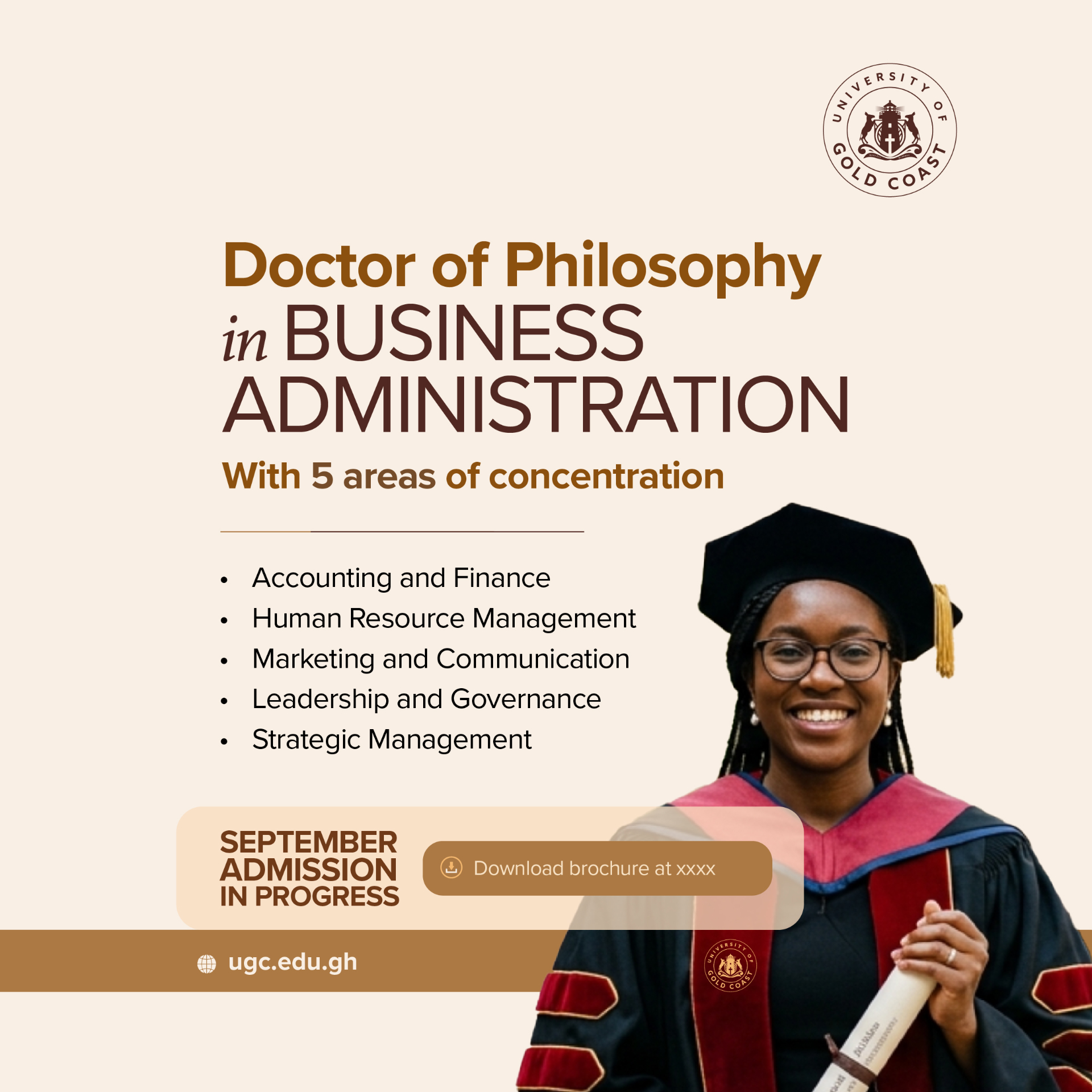
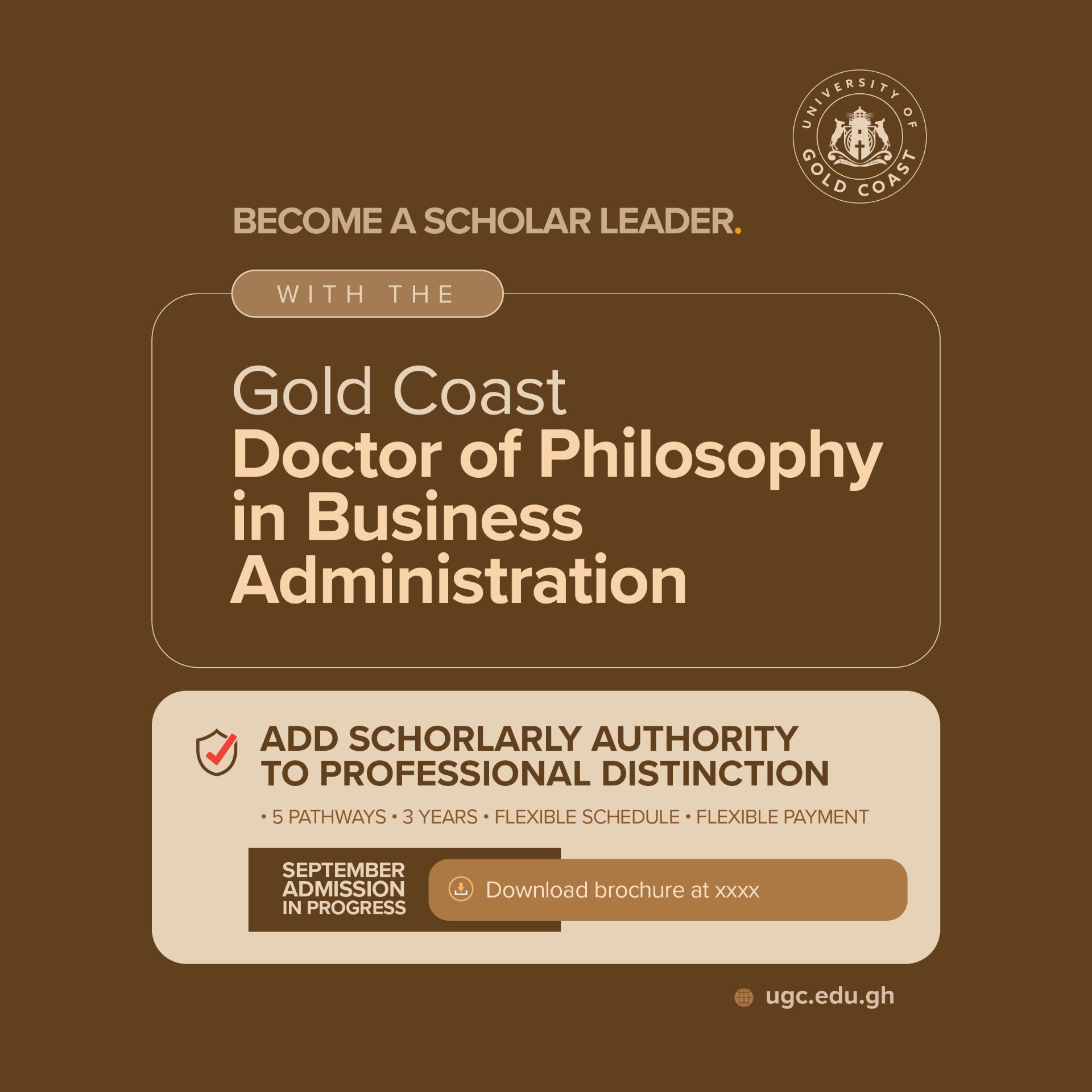
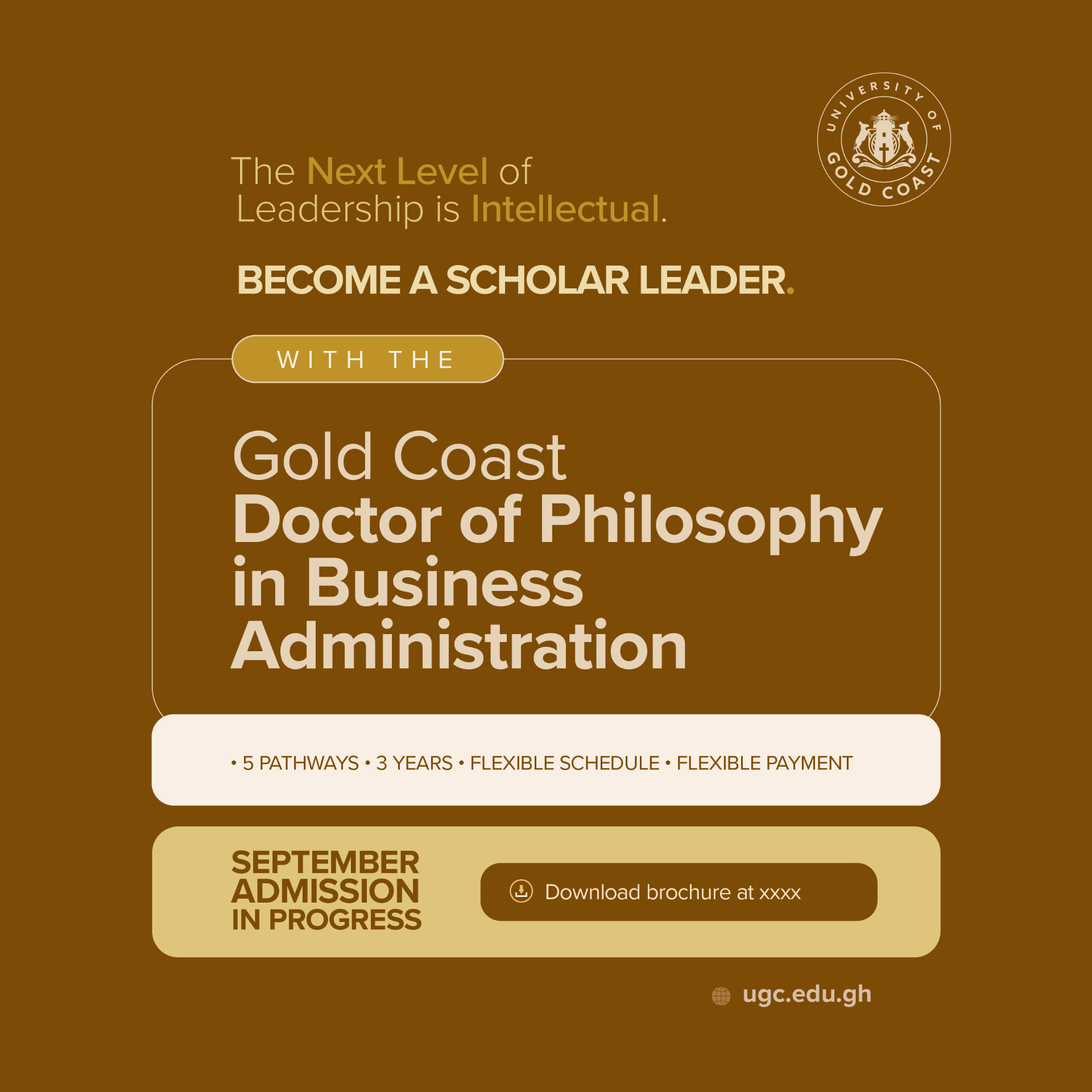
Doctor of Philosophy in Business Administration. Three years. Hybrid. Five fields of concentration.
Begin your applicationThe Scholar Leader
The programme unites professional distinction with academic authority in one integrated identity.
Earned through accomplishment, executive judgement and the ability to lead consequential change.
Established through rigorous research, intellectual independence and an original contribution to knowledge.
The result is a Scholar Leader who can generate and defend credible knowledge, then translate evidence into decisions across universities, boardrooms, ministries and institutions.
Why Gold Coast PhD?
Advanced methods, candidacy examinations, proposal defence, original thesis research and viva voce examination.
ExploreResearch grounded in African realities and strengthened through international scholarly engagement.
ExploreInquiry directed towards significant organisational, economic, leadership, governance and public-policy questions.
ExploreTwo study routes offer different schedules while preserving the same curriculum, supervision and doctoral standard.
ExploreCandidates develop a journal manuscript, policy or practice brief, research presentations and a teaching portfolio.
ExploreThe Global Immersions Programme extends doctoral learning through international masterclasses, roundtables and institutional visits.
ExploreProgramme Structure
The curriculum moves deliberately from intellectual foundations to independent research, publication and defence.
Build command of research philosophy, ethics, qualitative and quantitative methods, theory, evidence synthesis and concentration study.
Complete comprehensive examinations, develop and defend the proposal, refine research design and begin the academic apprenticeship.
Complete data analysis, develop a journal manuscript, present the thesis, demonstrate pedagogical competence and defend the research.
Concentrations
Choose a field in which your research can make a meaningful contribution.
Advance knowledge in reporting, finance, investment, taxation, assurance and managerial accounting.
Examine how talent, performance, culture and employment systems shape institutional capability.
Investigate markets, consumer behaviour, digital strategy, communication and service value.
Study authority, ethics, accountability, organisational change and corporate and public governance.
Explore competition, corporate strategy, governance, innovation, transformation and global strategy.
Study Routes
Both routes deliver the same curriculum, assessment, supervision, progression requirements and 180 synchronous contact hours each academic year.
The programme is designed for candidates whose professional responsibilities are substantial, but whose doctoral ambitions require no reduction in academic standard.
Attend three ten-day doctoral intensives in each academic year. Every intensive provides 60 contact hours and creates a protected period for advanced masterclasses, methods laboratories, disciplinary seminars, writing clinics, doctoral colloquia, supervision and milestone review.
Attend one intensive doctoral weekend each month. Every Friday to Sunday engagement provides 15 contact hours, enabling candidates to sustain a disciplined research rhythm alongside executive, academic and professional responsibilities.
Global Immersions
The Global Immersions Programme is the international doctoral summer-camp component of the PhD.
Doctoral research gains depth when ideas are tested across institutions, intellectual traditions and policy environments. Through summer camps in Europe and engagement with respected academic and professional communities, candidates encounter new research cultures, comparative institutional perspectives and international standards of scholarly argument.
The purpose is intellectual enlargement: comparison across contexts, refinement through external critique and relationships that can sustain a life of scholarship and leadership.
Led by international faculty and experienced doctoral supervisors.
Focused on research design, argument, publication and scholarly craft.
Present work, receive critique and engage the research of peers.
Illuminate how universities, enterprises and public bodies organise knowledge, governance and innovation.
With scholars, practitioner-researchers and doctoral communities.
Strengthens the global relevance of research grounded in African institutional realities.
Candidate Profile
The programme is for accomplished professionals and academics ready to undertake the demands of a genuine research doctorate.
Applicants should normally hold a master's degree in Business Administration or a related field from a recognised institution, with a minimum CGPA of 2.5 or its equivalent.
They should also demonstrate professional and research readiness and submit a research concept, statement of purpose, curriculum vitae and references.
Full requirements appear in the programme brochure.
Essential Questions
It is a Doctor of Philosophy in Business Administration: a research doctorate with advanced methodological preparation, original thesis research and viva voce examination.
The normal duration is three academic years, comprising 96 credits of advanced study, candidacy, research, publication development and thesis examination.
Yes. The hybrid structure is designed for professionals and academics with significant responsibilities. Candidates must still protect substantial time for reading, research and writing.
Yes. The programme has received the required regulatory approval, and the first cohort begins in October 2026.
Download the programme brochure or speak with a Doctoral Admissions Advisor for the full module structure, admission requirements, fees, calendar and policies.
Final Section · Apply
Your experience has shaped decisions. Now turn it into knowledge that can shape institutions.
Applications are open for the September 2026 intake.